Table of contents
- How the partnership started
- The home builder, and the moment everything changed
- The war room
- The email engine
- The luxury rebrand
- Lead qualification, end to end
- SEO and ad campaigns
- Rewiring operations
- What's next
How the partnership started
Pro Compact Estates came to us for a website. That was it. A single project for a Southern California compact-home builder, no long-term plan attached.
We built it. The site shipped. But while we were in there, we noticed something simple: PCE's prospects all asked the same questions before they ever spoke to a salesperson. What sizes? What floor plans? What does it cost with a different countertop? Could it have a porch?
So we built a small interactive configurator into the homepage that answered those questions live, using PCE's existing color palette and product photography. A user could spec out their compact home, see the price update with each choice, and submit a design they had already imagined.
That tool changed the conversation. PCE wasn't asking us to build a website anymore. They were asking us what else we could automate, redesign, or rebuild for them.
What started as a one-time project became a multi-phase engagement that now spans five custom software tools, three websites, a luxury rebrand, a 90-day email automation engine, an internal financial audit, and the operating dashboard their team uses every day.
This is the story of that engagement.
The home builder, and the moment everything changed
The original configurator was the seed. The expanded version is the centerpiece of the new site.
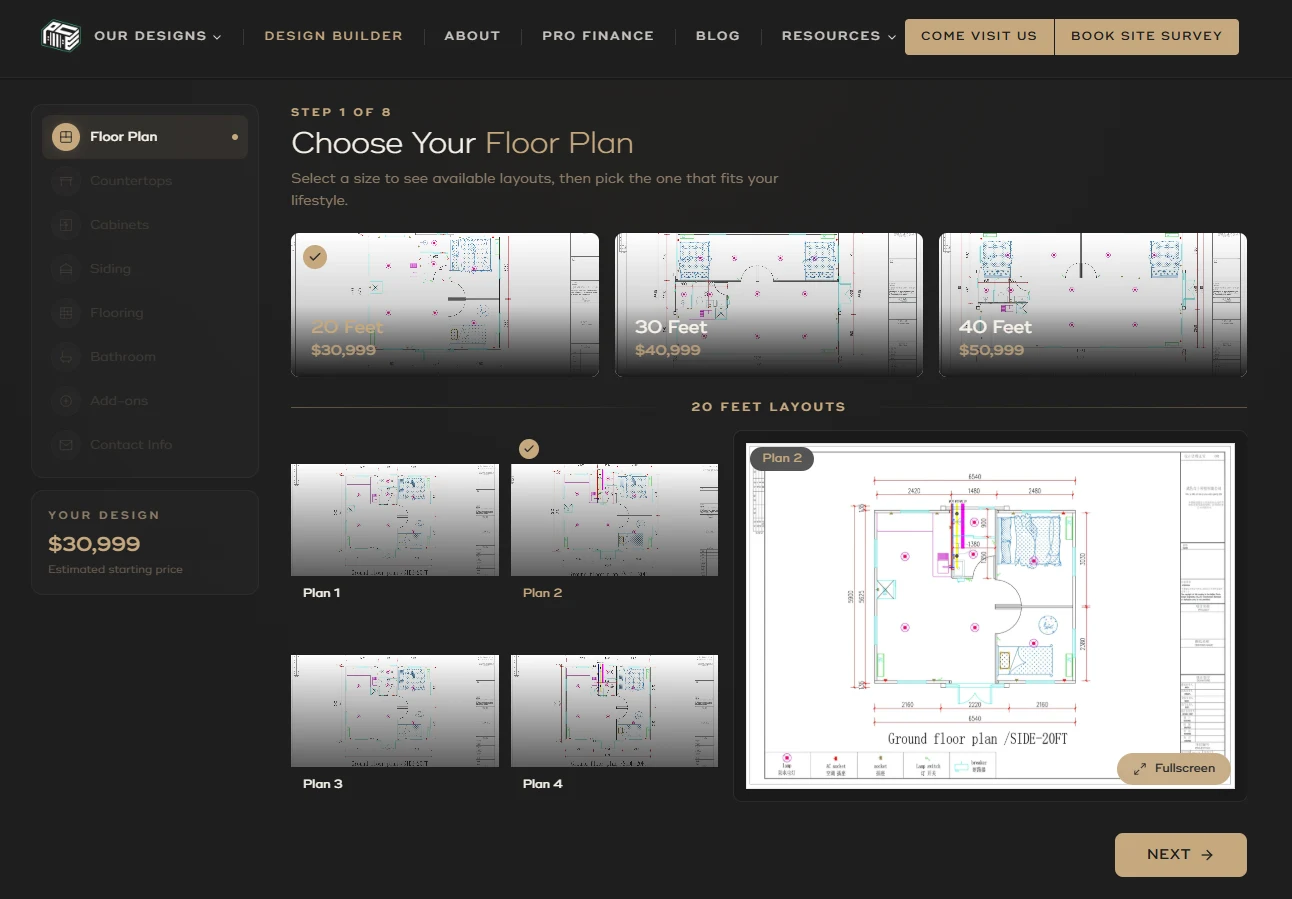 The 8-step builder configures floor plan, countertops, cabinets, siding, flooring, bathroom, and add-ons. Live price updates with every selection.
The current builder walks a buyer through eight steps. Floor plan and size first (20-foot, 30-foot, or 40-foot footprint, with multiple plan variants per size). Then countertops, with options like Pearl Quartz, Alpine White, Carrara Gold, Storm Grey, and Midnight Gold. Cabinets, siding, flooring, and bathroom finish next. The final step is add-ons: washer-dryer combo, front porch, deck, garage, smart-home package, and a few others.
Every selection updates the price live. Every selection persists. When the buyer hits the final step, their full configuration plus contact info posts to a lead-capture endpoint. By the time the PCE sales team picks up the phone, they already know exactly which home that customer wants.
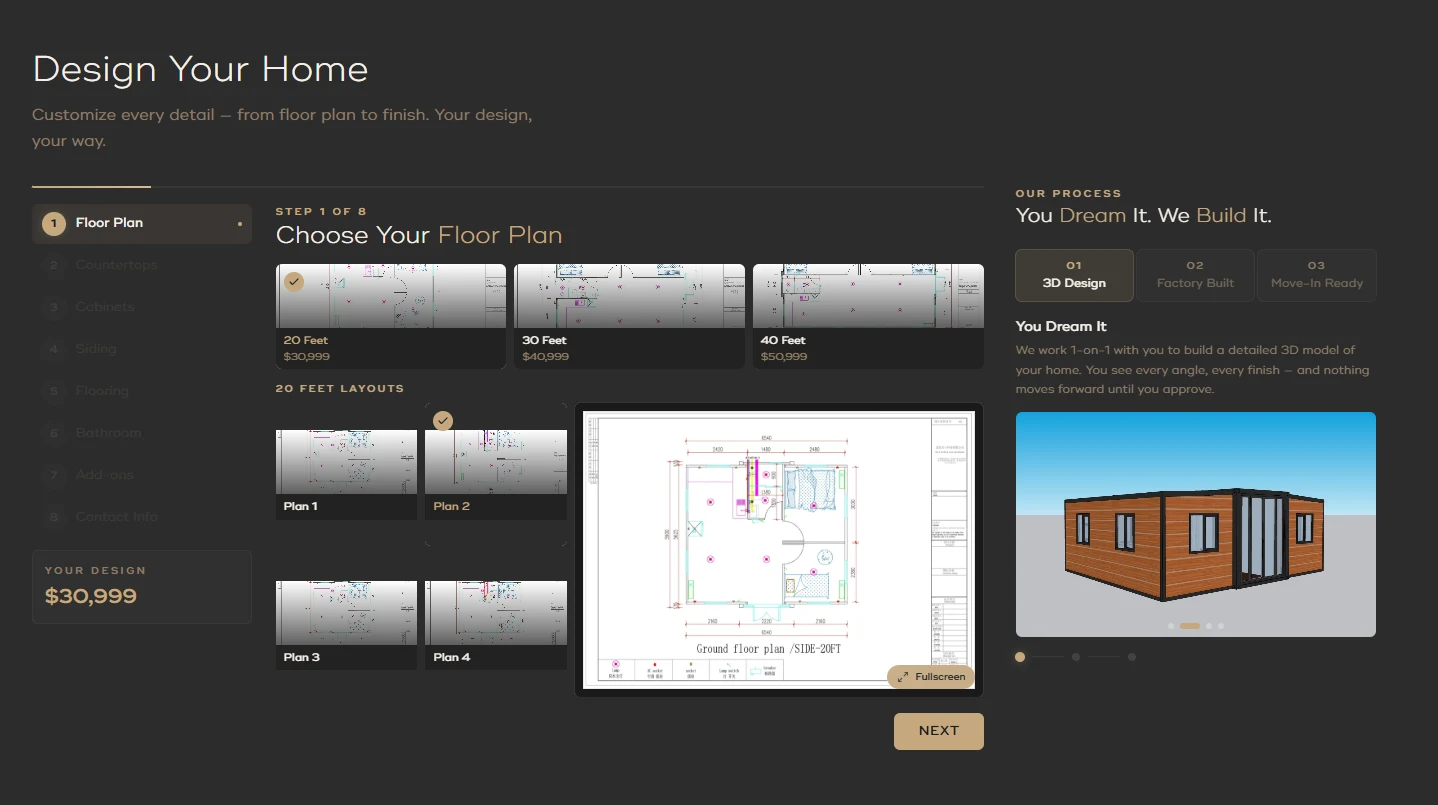 The same configurator runs in a compact inline form on the homepage, so prospects can play with it without ever leaving the landing page.
A note on the renders: the visuals are pre-rendered product photography, not real-time 3D. The reason matters. Real-time 3D renders are heavy, slow, and break on mobile. Pre-rendered images load instantly, look photographic, and let buyers commit emotionally to a specific finish before talking to anyone. The render style matches what they would see on the actual home.
The configurator is one of the highest-converting elements on the new site, and the lead it produces is qualitatively different from a contact-form submission. We don't get a name and an email. We get a name, an email, a phone number, and a complete spec for the home that prospect wants to buy.
The war room
Once the partnership extended past the first website, we needed a single place to track all the work we were planning across PCE's business. Marketing automation. SEO. Reports. Builder integrations. PostHog analytics. Reactive email. AI chatbot. Email automation. Mobile app. CRM. We mapped each of those workstreams as a tab in a custom dashboard PCE uses to stay current with everything we are running.
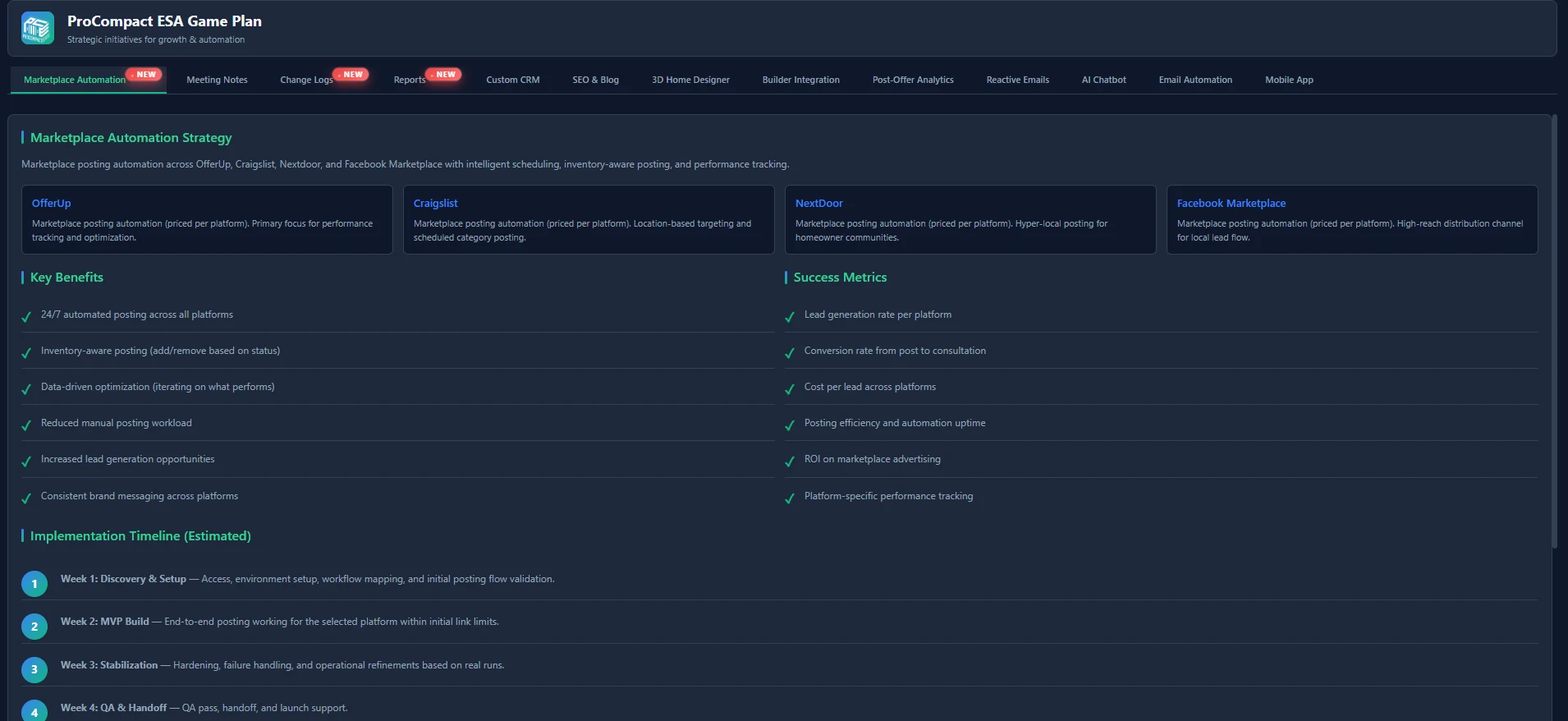 The dashboard's twelve tabs map to twelve active or planned workstreams. Each tab pulls in its own status, change logs, and reports.
The dashboard isn't a roadmap document. It's a live operating layer. The financial tab is interactive. The team uploads Bank of America and Chase CSV statements, the dashboard reconciles them against QuickBooks, and Chart.js renders cash-flow visualizations on the fly.
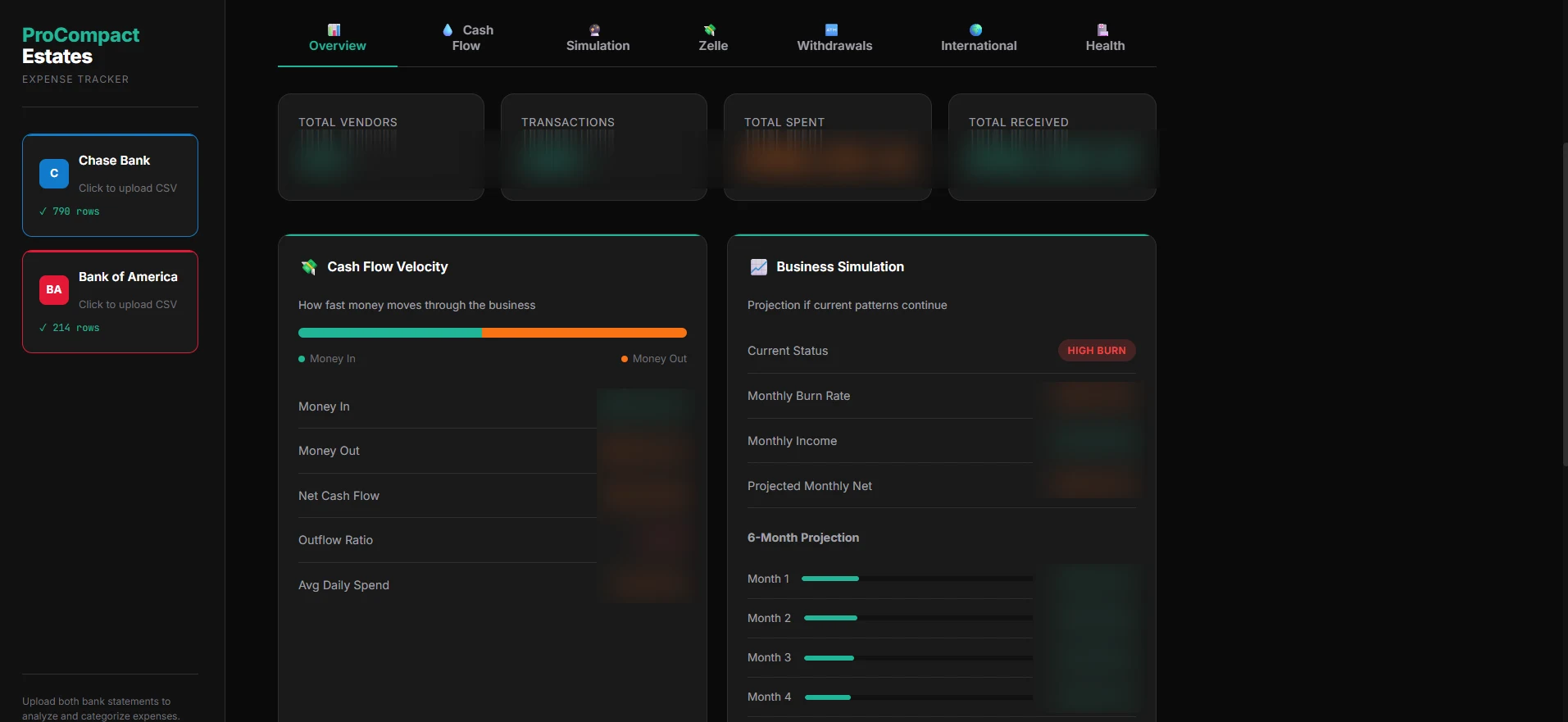 The financial dashboard reconciles bank statements against QuickBooks and renders live charts of revenue, expenses, and category spend.
The dashboard is password-protected and lives at a private URL. PCE's leadership opens it daily to see exactly what we shipped this week, what is in flight, and what is queued. We open it daily to confirm we are still aligned on priorities.
This single artifact replaced what would have been weekly status meetings, recurring email reports, and a Trello board nobody opens. One URL, twelve workstreams, always current.
The email engine
The email engine is the deepest single piece of software we built for PCE. It runs the 90-day reactive drip that converts cold leads from the configurator and contact form into booked consultations.
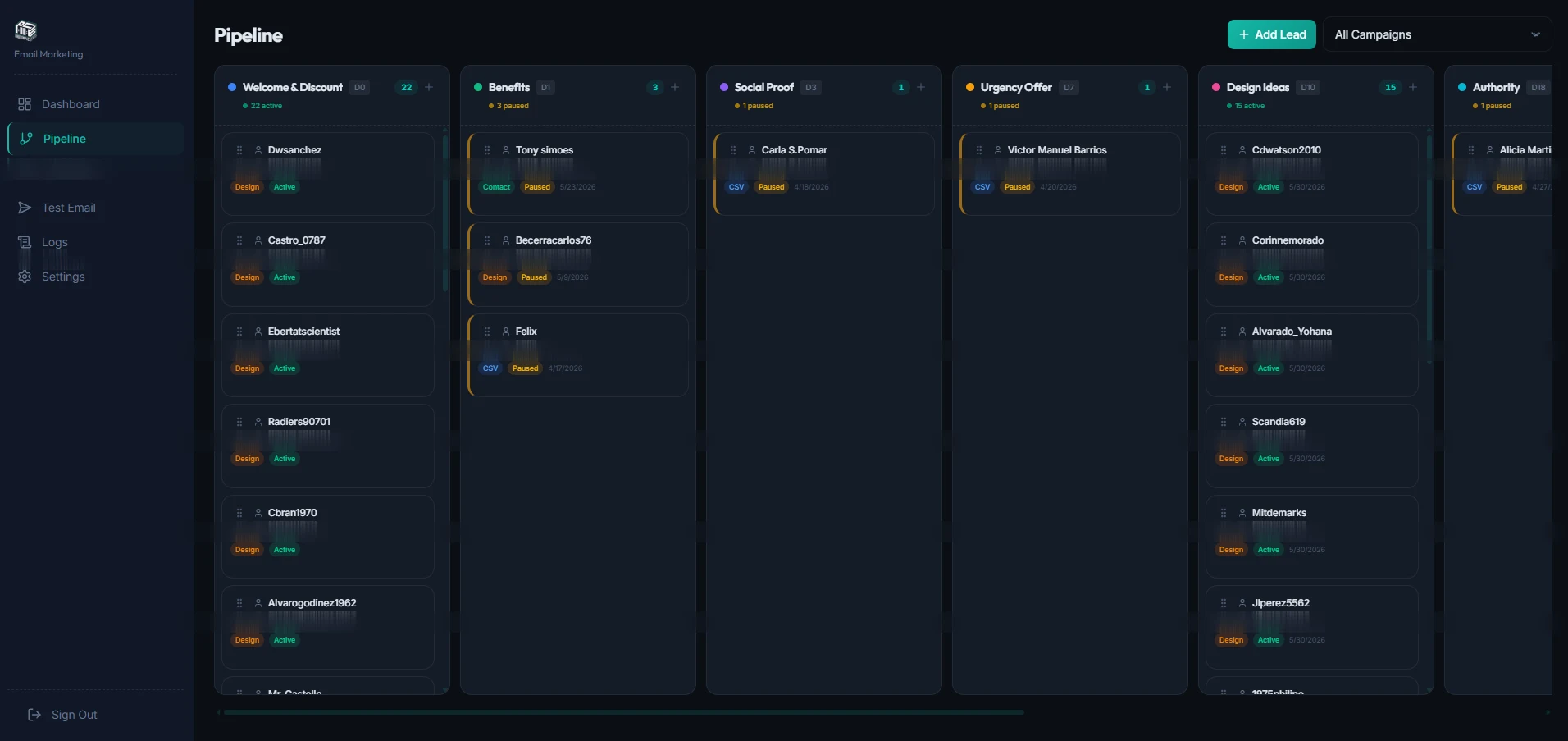 The Kanban pipeline shows every active lead by stage. PCE's team can drag a lead to a different stage, pause anyone who's gone cold, or discard leads that aren't real prospects.
The engine is a React 19 frontend on top of an Express backend, backed by Postgres. It supports three lead-source campaigns (contact form, design submission, CSV import), each with its own template set. Leads enter the system one of three ways: automatic sync from the website's contact-form database, CSV bulk upload (up to 5,000 rows at a time), or manual entry.
Once a lead is enrolled, it starts a nine-stage drip. The stages fire on day 0, 1, 3, 7, 10, 18, 30, 45, and 60. Each stage has its own template per campaign type, with Handlebars placeholders that personalize on the lead's name, design model, and discount code. A daily cron job at noon Pacific runs the batch. It queries every lead due for its next stage, renders the template, appends a tracking pixel and CTA links, and ships it via SMTP.
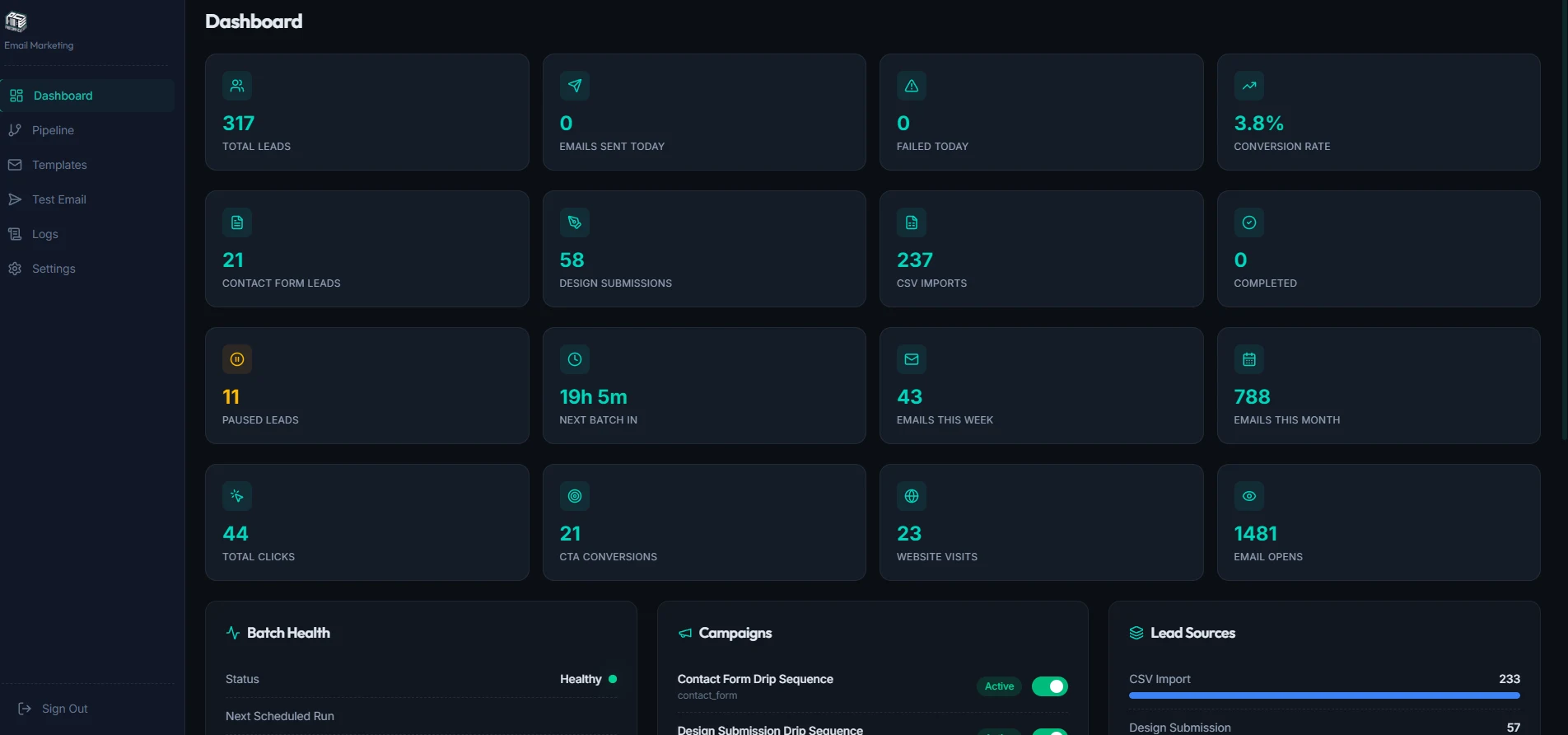 The dashboard surfaces every send: status, opens, clicks, errors. The funnel chart shows lead progression across all nine stages.
The interesting part is what happens when the lead engages. If they click the CTA (a Calendly link or a "Book Site Survey" button on the website), the system auto-pauses their sequence. They're already moving toward booking, no need to keep nudging them. If they click any tracked link, it logs the event with timestamp and stage. Every send, every open, every click is searchable in a full audit log.
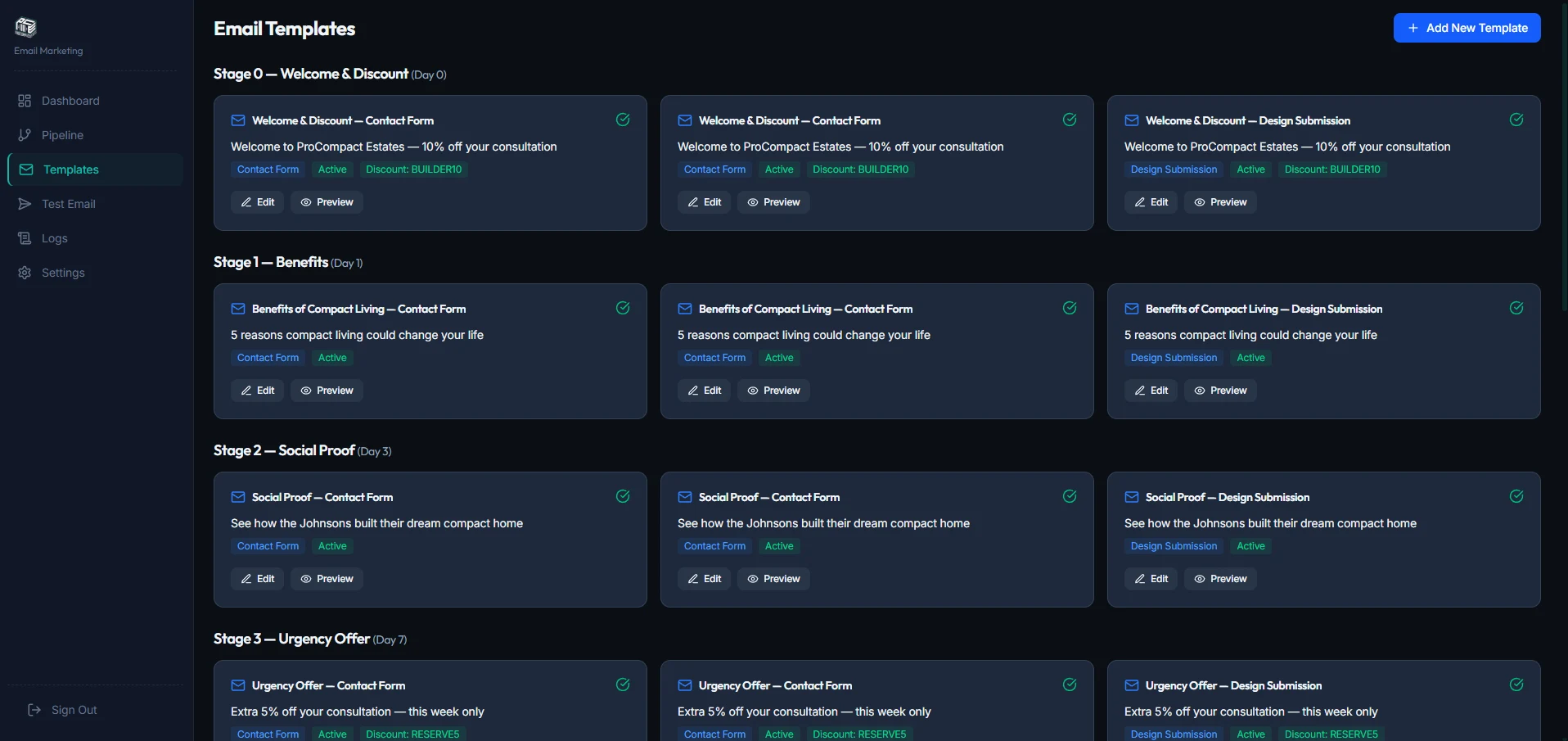 Nine email templates live in an in-app editor. PCE's team can rewrite a stage-3 email without touching code.
PCE's team can rewrite any of the nine templates without touching code. Discounts and incentives toggle per stage, so they can offer a 5% discount at day 7 to anyone who hasn't booked yet, then a 10% discount at day 18 if they still haven't engaged. The whole thing is wrapped in JWT auth so PCE's team and ours can both operate it.
The luxury rebrand
Halfway through the engagement, PCE's leadership made a strategic call: the brand needed to feel different. The original site read like a friendly local home builder. They wanted it to read like a high-end product company.
We did a full one-eighty.
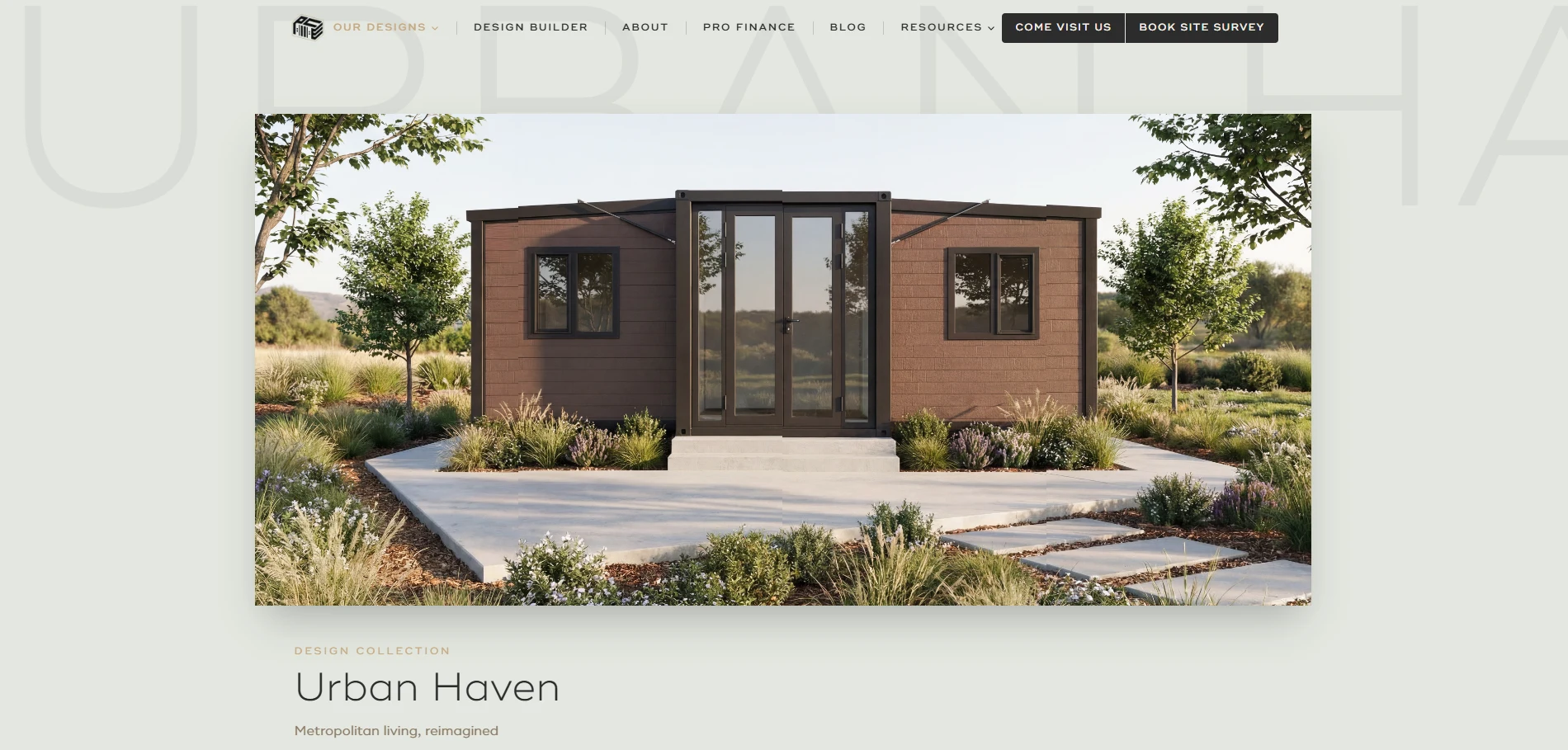 The new site is built on Vite + React 19 + Tailwind 4. Hero parallax and section transitions run on GSAP. Each of the three Haven models has its own editorial page.
The product line was renamed and structured around three Haven models, Urban Haven, Pro Haven, and Grand Haven, each with its own model page, parallax hero, gallery, and editorial sections. Financing is built directly into the configurator and the standalone Pro-Finance page through a partnership with Hearth, which lets PCE offer pre-qualified loan terms inside the buying flow. A buyer can configure their home, see their price, see their estimated monthly payment, and apply for financing without ever leaving the site.
The previous site treated photos as decoration. The new site treats photos as the product. The Projects page is a masonry gallery of seventeen real installations from PCE's Podium series, photographed at the same level of polish you'd expect from a furniture catalog.
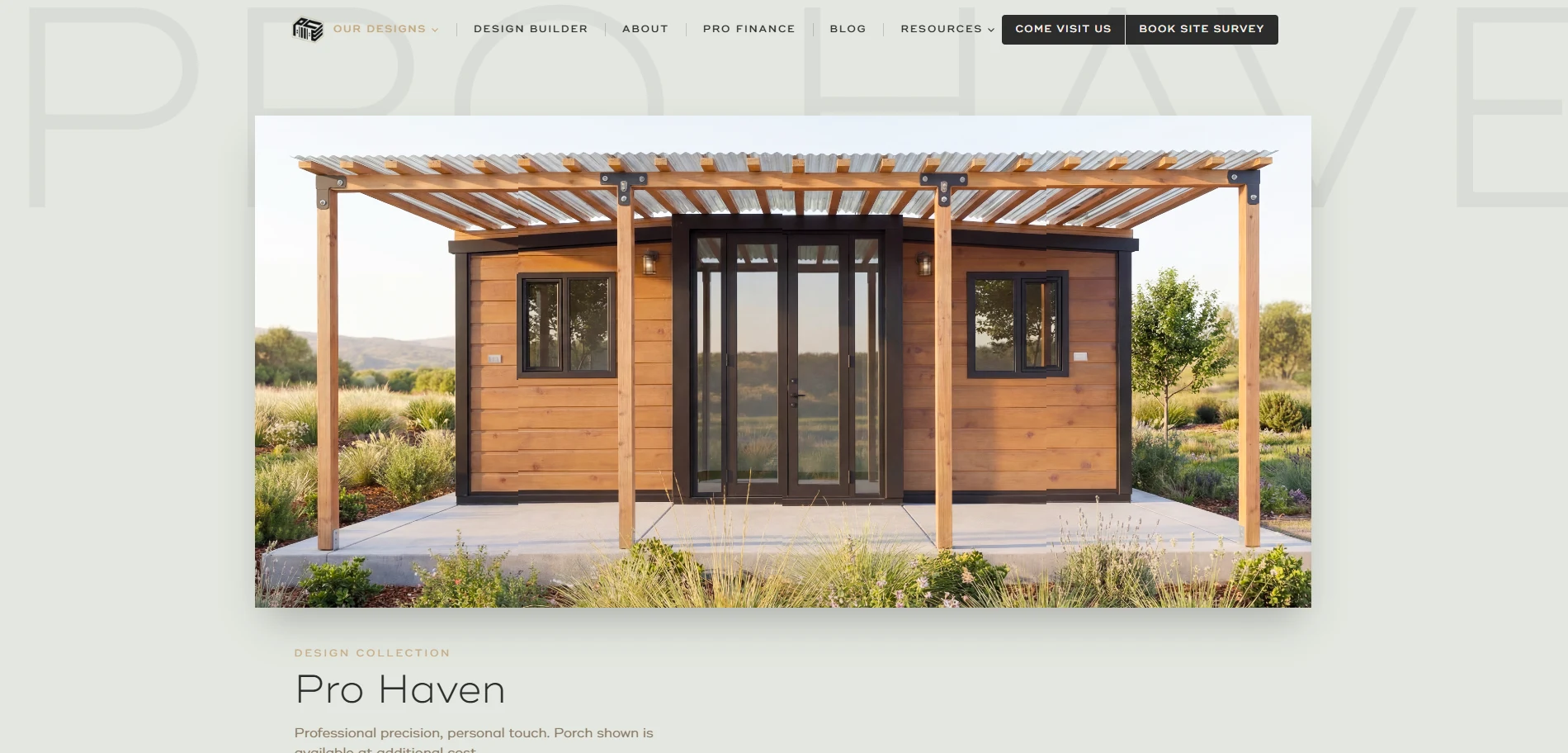 The Projects page shows seventeen real installations. Buyers see what they're actually buying.
Our graphic designer produced print collateral to match: brochures, pamphlets, advertisement layouts. PCE now has a coherent visual identity across web, print, and ads, the exact opposite of the disconnected "every channel looks different" experience most local builders ship with.
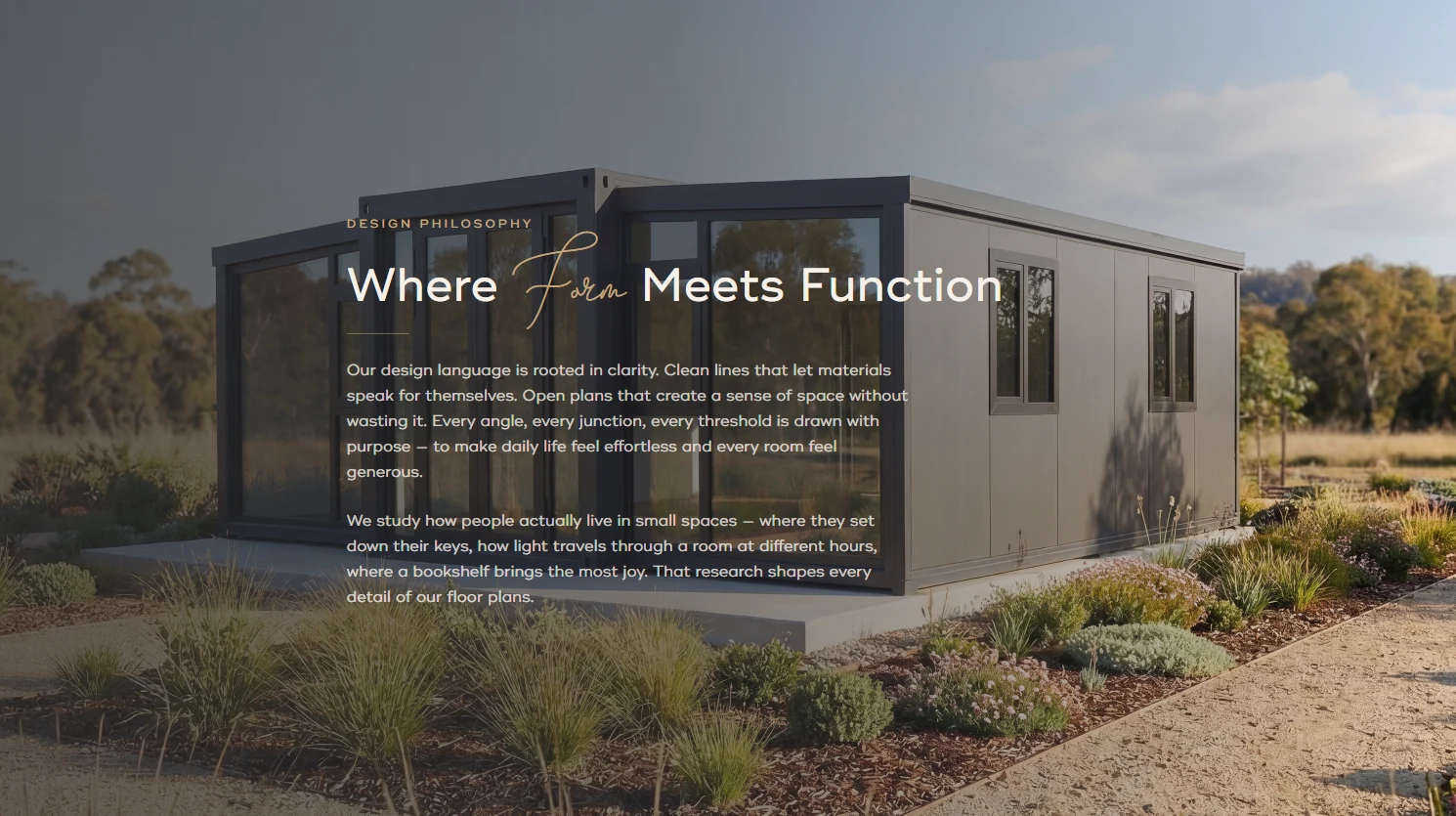 Brochures, pamphlets, and ad layouts produced by our graphic designer match the new digital identity.
Lead qualification, end to end
Once a lead drops into the system from any source (website form, configurator submission, ad campaign, walk-in), it has to get qualified fast. Cold leads go cold quickly in a sales cycle this long.
PCE adopted Go High Level as their CRM. We built around that decision. Every lead source feeds Go High Level, and Go High Level feeds the email engine and the dashboard. One contact in, three systems updated.
We're also piloting an AI voice agent that calls older leads who've gone quiet. The pilot's job is to re-open the conversation, ask a few qualifying questions, and either book the lead onto the calendar or mark them as cold so PCE's team doesn't waste manual outreach. The pilot runs on a third-party voice platform we configured. It's not a Frankenstein build. We're tracking conversion data now and moving the pilot toward daily ops once it's clearing the threshold we set.
The point of the qualification layer isn't replacing the sales team. It's making sure the sales team only spends time on leads who are actually ready to buy.
SEO and ad campaigns
We did a full SEO audit on the existing site, then a full SEO push across the new luxury site. Site structure, schema markup, page speed, internal linking, keyword targeting, and on-page content all got rebuilt for search. PCE now ranks number one on Google for the core terms that drive their business in Southern California.
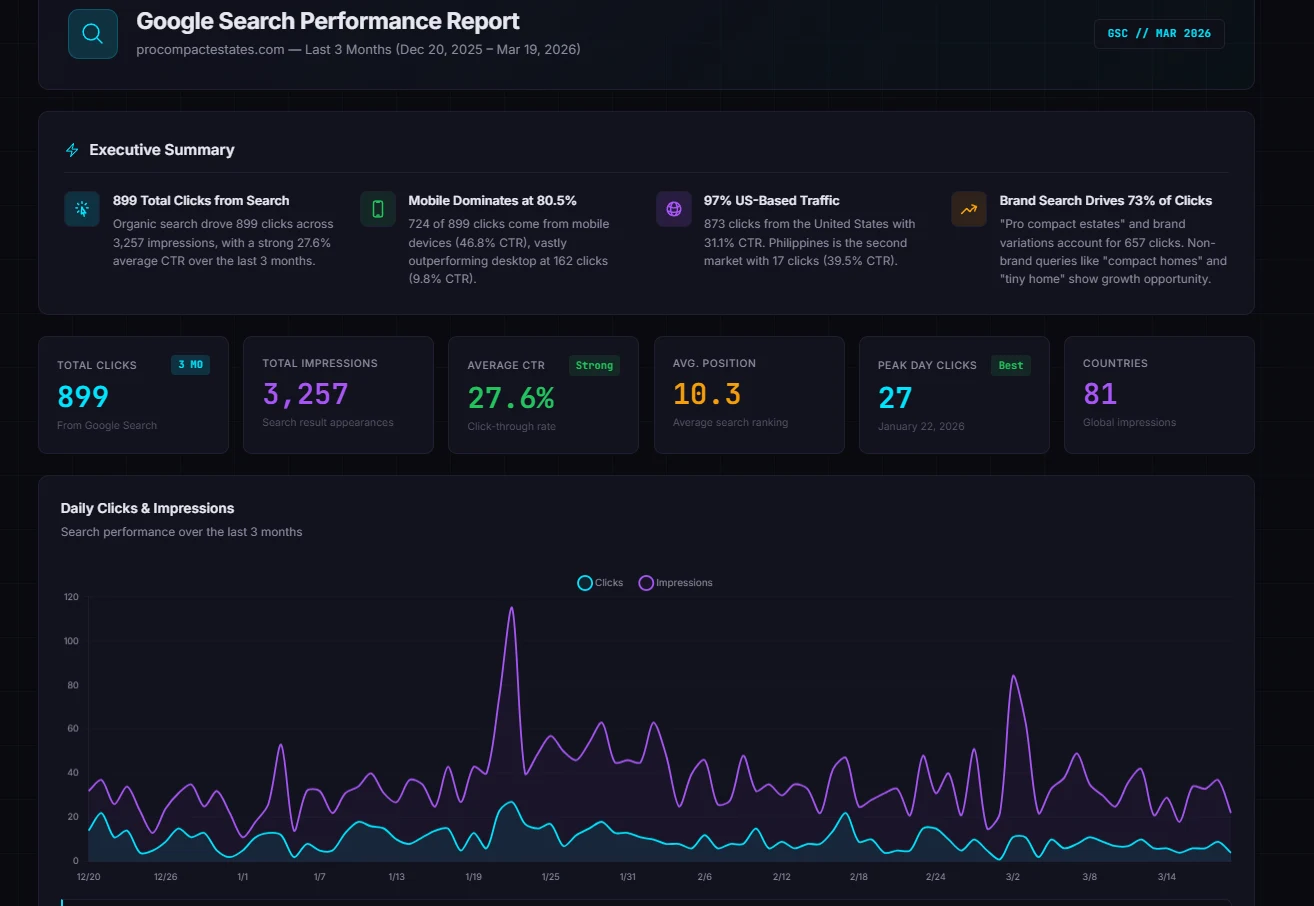 The dashboard surfaces a PostHog quarterly report so PCE's leadership can see funnel performance in plain English.
Once the SEO baseline was solid, we layered ads on top. We run Google and Facebook campaigns, A/B test the creative and copy, and feed every click into PostHog. PostHog is wired into every page of the new site. Design-builder steps, hero clicks, contact form submissions, model views, checkout, consultation scheduling. We can answer questions like "which ad creative drove configurator completions in March?" with a real number.
The directional outcome: the more we run, the more sales come in. SEO and ads aren't separate from the rest of the engagement. They feed the configurator, which feeds the email engine, which feeds Go High Level, which feeds the dashboard. Every dollar of ad spend is attributable to a specific funnel step.
Rewiring operations
A great website doesn't fix a back office. So we went into the back office.
We took over PCE's QuickBooks for a full audit. Six months of transactions reviewed line by line, recategorized to a clean chart of accounts, and mapped to new categorization standards going forward. We set policies for how transactions get tagged so the books stay clean without manual rework.
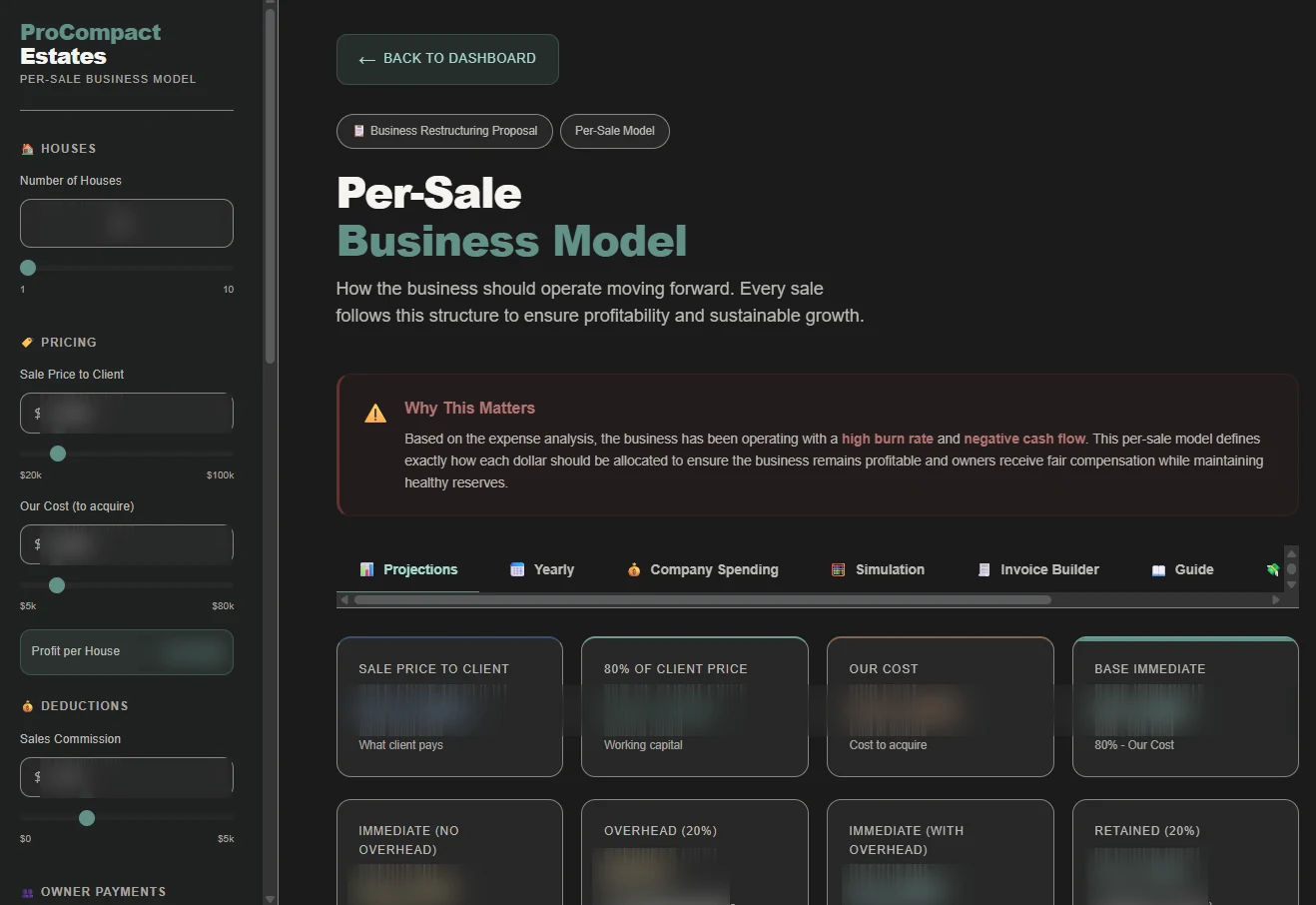 A profit calculator inside the dashboard models margin per design line, per add-on, per finish. PCE leadership now sees margins before quoting, not after invoicing.
The operational impact: PCE went from around ten employees to three solid operators. Not because we cut anyone. Because the software did the parts of the job that used to require headcount. A 90-day email engine replaces an outreach VA. A dashboard replaces a status-meeting cadence. A configurator replaces a sales engineer's first thirty minutes.
When we started, PCE's books were heading into the red. They are now firmly in the black, putting up hundreds of thousands of dollars in annual revenue, growing month over month as the SEO and ad pipeline matures.
What's next
The engagement isn't done. Several pieces are in active development or queued:
- A custom AI chatbot that answers PCE's most common buyer questions in real time, integrated with the configurator and the email engine so a chatbot conversation can hand off cleanly to either a sales rep or the drip sequence.
- A full marketing automation platform built around Go High Level as the system of record, with cross-channel sequencing across email, SMS, and AI voice.
- A mobile app for PCE's customers post-purchase: real-time build status, photos from the build site, scheduled milestone updates, and a direct line to the project manager. Customers stop calling PCE every week to ask for updates because the app already shows them.
- Continued operational instrumentation. Every part of the business that still runs on a spreadsheet is a candidate for automation.
The pattern is the same one we've used from day one. Every new tool plugs into the existing web of tools. The configurator feeds the email engine. The email engine feeds the dashboard. The dashboard surfaces the metrics that drive the next decision. The result is a single connected system, not five disconnected SaaS subscriptions duct-taped together.
Pro Compact Estates didn't hire a website agency. They hired a software partner who happened to start with a website. The partnership keeps producing because the software keeps producing.